
Broken Bottles on Beaches Point to Behavioural Gaps in Waste Disposal
By Impact Desk | Updated: March 11, 2026 17:26 IST2026-03-11T17:26:00+5:302026-03-11T17:26:10+5:30



Goa’s beaches are central to its tourism economy, but they have also become sites where the limits of the state’s ...
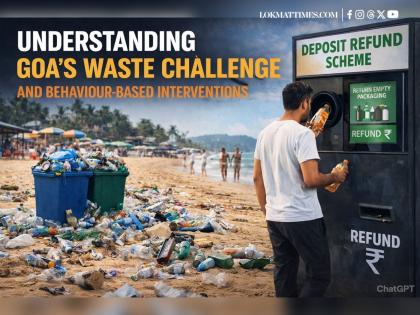
Broken Bottles on Beaches Point to Behavioural Gaps in Waste Disposal
Goa’s beaches are central to its tourism economy, but they have also become sites where the limits of the state’s waste management system are increasingly visible. Among the most serious consequences is the growing incidence of injuries caused by broken glass bottles left on the sand, a problem acknowledged by both legislators and government officials in recent years
Concerns over tourist safety reached the floor of the Goa Legislative Assembly in July 2025, when lawmakers raised complaints about visitors being injured by shards of glass scattered across popular beaches
The Tourism Minister has pointed out that in a state receiving exceptionally high tourist volumes, particularly during peak seasons, the effectiveness of enforcement is naturally constrained by the scale and dispersion of waste generated across open public spaces such as beaches and coastal areas.
These injuries are not isolated events but symptoms of a broader pattern. Reporting compiled across multiple outlets documents how beaches, highways, rivers, and forests are repeatedly littered with alcohol bottles, water containers, and food packaging, particularly during peak tourist seasons
Goa generates around 800 tonnes of municipal solid waste each day, with nearly half of it classified as non-biodegradable. Glass bottles form a visible and hazardous part of this waste stream, especially in coastal areas where consumption often occurs outside household settings.
Tourism intensifies this risk. With a resident population of approximately 15 lakh and tourist arrivals nearly ten times higher annually, waste generation spikes sharply during peak periods. Once discarded, glass bottles are easily broken underfoot or by tidal movement, turning litter into a direct safety hazard.
Discussions within the state administration have also highlighted the practical limits of enforcement-led approaches in a tourism-driven environment. In high-footfall locations where consumption occurs continuously and outside household settings, managing waste effectively requires measures that operate closer to the point of disposal.
Clean-up drives can temporarily remove broken glass, but they do not change disposal behaviour at the moment bottles are consumed. As a result, the same hazards reappear with each tourist cycle.
It is in this context that a deposit-based approach has been proposed as a corrective tool. The Deposit Refund Scheme introduces a refundable deposit on glass bottles at the point of sale, which is returned when the empty container is brought back intact. For alcoholic glass bottles, the refundable deposit is set at ₹10 per bottle, irrespective of product price
The logic is straightforward: when a bottle carries a guaranteed monetary value, it is less likely to be discarded on the beach or broken underfoot. This mechanism directly addresses the safety problem that fines have struggled to deter. Even if a consumer does not personally return a bottle, its deposit value ensures that someone else likely will. The incentive shifts behaviour from avoidance to retrieval, reducing the chance that bottles are left behind to shatter in public spaces.
International evidence shows that deposit systems consistently reduce litter for covered items by 40 to 90 percent, with near-elimination of beverage container litter in several jurisdictions. While Goa’s context differs, the behavioural principle remains the same. Injury risk falls when bottles are returned cleanly and quickly, rather than broken and dispersed.
Importantly, the scheme does not replace existing waste laws or clean-up efforts. It operates alongside them, reducing the volume of hazardous material entering public spaces in the first place. For beaches, this means fewer broken bottles, fewer injuries, and less reliance on reactive bans or emergency clean-ups.
The issue of tourist injuries from broken glass has already prompted calls for restrictive measures. A deposit-based system offers an alternative that targets the root cause of the problem: disposal behaviour at the point of consumption. As Goa continues to manage the pressures of high tourist footfall, reducing preventable injuries on its beaches is not only a matter of cleanliness, but of public safety.
Open in app
