
Maharashtra's Tiger Epic: How Tadoba Became the Setting for India's Most Ambitious Wildlife Series
By Impact Desk | Updated: March 16, 2026 17:47 IST2026-03-16T17:47:38+5:302026-03-16T17:47:44+5:30



In the dense teak forests of Chandrapur, where the Tadoba-Andhari Tiger Reserve shelters one of the highest concentrations of ...

Maharashtra's Tiger Epic: How Tadoba Became the Setting for India's Most Ambitious Wildlife Series
In the dense teak forests of Chandrapur, where the Tadoba-Andhari Tiger Reserve shelters one of the highest concentrations of Royal Bengal Tigers anywhere on Earth, a quiet revolution in Indian filmmaking has been unfolding. Over seven years, a husband-wife team from Brave Age Films embedded themselves in this landscape to create Tiger Legacy: a four-part natural history series that has now placed Maharashtra's wildlife firmly on the global stage.
A State's Forests, Reimagined for the World
For most Indians, the mention of tiger country conjures images of Rajasthan's Ranthambore or Madhya Pradesh's Bandhavgarh. Yet Maharashtra's Tadoba-Andhari Tiger Reserve, tucked into the Chandrapur district of Vidarbha, has quietly emerged as one of the subcontinent's most extraordinary wildlife theatres. With a thriving population of over ninety tigers spread across its core and buffer zones, Tadoba rivals any reserve in Asia for density and the sheer frequency of sightings. It is this landscape that internationally acclaimed Cinematographer Filmmaker Sumesh Ashok Lekhi and producer Rashmi Lekhi chose as the canvas for Tiger Legacy: a four-part, hour-long natural history series that chronicles the intersecting lives of four tigresses, their mates, and their cubs. Conceived in 2016 and completed over seven painstaking years, the series premiered its official trailer at Cannes as part of the Jewels from India showcase—a milestone that no Indian wildlife documentary had previously achieved.
The Maharashtra Connection
What makes Tiger Legacy resonate so powerfully for Maharashtra is not merely that it was filmed here. The Lekhis made a deliberate choice to root the production in the local landscape and its people. A significant share of the crew—including technicians, field assistants, and naturalists—came from communities around Tadoba itself. Sumesh Ashok Lekhi having researched and filmed tigers for over a decade, combined local knowledge to track routes, seasonal patterns and animal behavior to chart out the script and eventually the series. The involvement of Gond tribal communities, whose ancestral connection to these forests predates recorded history, lent the production both practical insight and cultural depth. Tadoba takes its very name from Taru, a Gond chieftain said to have encountered a tiger at the banks of the lake that now bears his name. Tiger Legacy, in a sense, continues that ancient dialogue between the people of this region and its apex predator.
Beyond the Predator-Prey Formula
Conventional wildlife filmmaking tends to reduce tigers to a sequence of hunts and confrontations. Tiger Legacy takes a fundamentally different approach. The sheer scale of the project is staggering; the script and research notes alone exceed 130,000 words. Because tigers are highly territorial, the team followed individual cats for seven years, tracking each litter of cubs for almost two years. Relying on distinct stripe patterns, the team meticulously catalogued left flank, right flank, and face photos for reference. Back on the editing table, footage was rigorously sorted into specific bins labeled with individual tiger and litter names, ensuring that only timeline-accurate shots were pulled for the narrative.
This scientific rigor translates to unprecedented on-screen moments. While tigers are known as solitary hunters, Tiger Legacy captures a groundbreaking sequence: a mother alongside her four grown, pre-independence cubs doggedly stalking and tiring a massive Gaur (megafauna) together. The series also delves into fascinating behavioral subtleties, revealing, for instance, why tigers enter waterbodies backwards. By submerging their bulk at the deeper end first, they cool off while keeping their faces and eyes dry. This allows them to doze at the water's edge while remaining perfectly alert to threats or hunting opportunities, ready to lunge forward. Furthermore, with their faces near the land, mothers can easily keep a watchful eye on young cubs playing at the water's edge.
Structured into four episodes, the series weaves these intimate details into the broader ecology of Tadoba: seasonal transitions, the movements of leopards and wild dogs, and the behavioral traits of sloth bears. At its center is Maya, one of India's most celebrated wild tigresses, surrounded by a cast including Choti Tara, Matkasur, and Chota Matka, whose territorial overlaps and cub-rearing struggles create a narrative with the complexity of generational fiction.
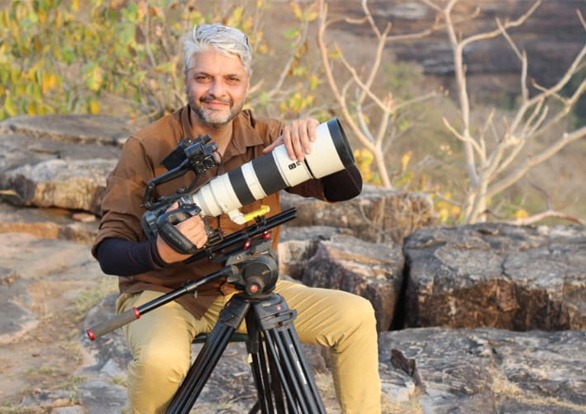
We didn’t set out to make a nature film that happens to be in Maharashtra. We set out to let Maharashtra’s forests tell their own story. Tadoba wrote the script. We followed.”
— Sumesh Lekhi, Director, Tiger Legacy
Putting Vidarbha on the Global Wildlife Map
The Cannes premiere is significant beyond prestige. International wildlife-filmmaking circuits have historically been dominated by productions set in East Africa’s Serengeti or Rajasthan’s desert forts. Tiger Legacy’s success signals that Vidarbha’s forests can command the same attention—and that Indian filmmakers, working with local crews and knowledge, can produce content that competes on a global stage.
For Tadoba’s surrounding communities, the implications are tangible. A documentary of this calibre functions as a sustained, high-quality showcase for the region, reinforcing for both international and domestic audiences that world-class wildlife experiences exist right here in Maharashtra.
A Blueprint for Conservation Storytelling & The Sahyadri Project
India shelters nearly seventy-five per cent of the global tiger population. While Tiger Legacy stands as a monumental archive of Tadoba’s ecology, the creators are already looking toward their next ambitious endeavor. Recognizing that not everyone is subscribed to platforms like Discovery and Animal Planet—or able to catch broadcasts on fixed cable TV schedules—Brave Age Films is actively removing barriers to access.
To make vital conservation stories readily accessible to everyone, they are developing a new, upcoming Docu-Podcast series focused on the Sahyadri landscape. This new project will be released directly on social media platforms, bypassing traditional gatekeepers to bring the wild straight to the public's screens.
As Maharashtra continues to invest in its tiger corridors, projects like Tiger Legacy and the upcoming Sahyadri series stand as a powerful reminder: the forests of our state hold stories as dramatic as anything produced in a studio. They simply needed someone patient enough to listen.
Open in app