
Mumbai: GMLR Twin Tunnel Project Hits Key Milestone As Launching Shaft Completed At Dadasaheb Phalke Chitranagari
By Lokmat Times Desk | Updated: March 7, 2026 16:14 IST2026-03-07T16:13:28+5:302026-03-07T16:14:07+5:30



The twin tunnel project at Dadasaheb Phalke Chitranagari, which forms a key component of the Goregaon–Mulund Link Road (GMLR), ...
Mumbai: GMLR Twin Tunnel Project Hits Key Milestone As Launching Shaft Completed At Dadasaheb Phalke Chitranagari
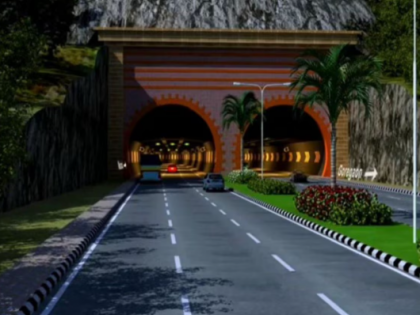
The twin tunnel project at Dadasaheb Phalke Chitranagari, which forms a key component of the Goregaon–Mulund Link Road (GMLR), achieved an important milestone on Thursday with the completion of its launching shaft. Work on concreting at the site is currently in progress and the curing process is expected to be completed within the next three days. Once the curing is finished, the next stage of construction will begin with the installation of Tunnel Boring Machines (TBMs). Officials have scheduled the lowering of the TBMs into the shaft for March 10, 2026, marking a significant step forward in one of Mumbai’s major infrastructure development initiatives.
The ambitious project includes the construction of a 4.7-kilometre-long twin tunnel beneath the forested area of Sanjay Gandhi National Park along with a 1.6-kilometre box tunnel passing through the premises of Dadasaheb Phalke Chitranagari. Two advanced Tunnel Boring Machines will be used to carry out the excavation work. According to officials from the Brihanmumbai Municipal Corporation, a specially designed curved concrete cradle measuring 20 × 20 × 2.5 metres has been constructed at the base of the shaft to support the heavy machines. The installation will require two cranes with capacities of 350 and 800 metric tonnes to carefully lower the massive equipment.
Authorities stated that the 350-tonne crane required for the lifting operation has already been installed at the construction site. Meanwhile, all parts of the larger 800-tonne crane have arrived and are currently being assembled. Officials expect the crane to become fully functional by March 7. After assembly, a load testing procedure will be conducted on March 8 to ensure safety and operational readiness. Once the test is successfully completed, the 800-tonne crane will begin lowering the various TBM components into the launching shaft. This step is crucial for initiating the tunnel excavation phase of the project and maintaining the construction timeline.
After the load testing process is completed, engineers will begin assembling the key components of the Tunnel Boring Machine at the site. These parts include the main shield, cutter head, screw conveyor, main bearing and erector. Officials aim to complete the assembly within the planned schedule so that excavation activities can begin without delay. Abhijeet Bangar, Additional Municipal Commissioner (Projects), has instructed officials and contractors to ensure that the tunnel excavation work begins at the site by June. The directive has been issued to maintain momentum in the project and meet the overall construction deadlines.
During his visit on Thursday, Bangar also reviewed the ongoing flyover construction at Ratnagiri Junction in Goregaon. Work on building the pier caps for the flyover is currently underway. He directed engineers to accelerate the process of launching girders so that the structure can progress quickly. The civic administration has stressed the importance of finishing each phase of the project according to the schedule. Officials have been asked to deploy additional manpower, machinery and resources to speed up work so that the flyover can be opened to motorists by May 31, 2026, before the arrival of the monsoon season.
The 12.2-kilometre-long Goregaon–Mulund Link Road is designed to connect the Western Express Highway at Goregaon with the Eastern Express Highway at Mulund. Once completed, the corridor is expected to significantly reduce travel time between the two points from around 75 minutes to just 25 minutes. The large-scale infrastructure project is being executed in four phases and carries an estimated cost of ₹16,000 crore. When finished, it will greatly improve east–west connectivity across Mumbai and ease traffic congestion across key transport routes in the city.
Open in app