
Andhra: TDP defends renaming of MNREGA
By IANS | Updated: December 18, 2025 16:30 IST2025-12-18T16:29:00+5:302025-12-18T16:30:09+5:30


Amaravati, Dec 18 Telugu Desam Party (TDP) defended renaming MGNREGA as VB-G RAM G, saying it reflects new ...
Andhra: TDP defends renaming of MNREGA
Amaravati, Dec 18 Telugu Desam Party (TDP) defended renaming MGNREGA as VB-G RAM G, saying it reflects new economic realities.
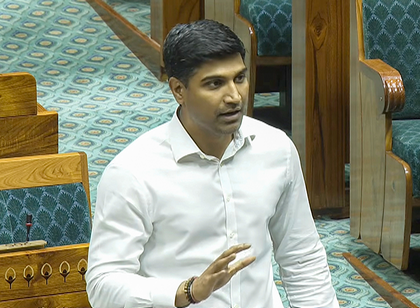
TDP MP Lavu Sri Krishna Devarayalu said that rural employment programmes have existed since 1969 in multiple forms and iterations, long before MNREGA was introduced in 2005.
He was speaking in Lok Sabha during the discussion on Viksit Bharat – Guarantee for Rozgar and Ajeevika Mission (Gramin) (VB-G RAM G) Bill, 2025, which seeks to repeal the Mahatma Gandhi National Rural Employment Guarantee Act (MGNREGA), 2005.
The TDP parliamentary party leader said that over the decades, schemes such as the Rural Employment Programme, Jawahar Rozgar Yojana, and Jawahar Gram Samriddhi Yojana eventually culminated in MNREGA.
“The current proposal is another necessary iteration in 2025, reflecting new economic realities and implementation experiences,” he said
He argued that the changes being introduced reflect evolving aspirations of the people, shifts in the economy, and developmental progress witnessed over the last 15 years.
“The central theme repeatedly mentioned in this House is change, which is the only constant in governance and public policy,” he said.
The MP stated that every decade has had its own defining focus: the 1960s on nation-building, the 1970s on Garibi Hatao, the 1980s on Roti Kapda Makaan, the 1990s on liberalisation, the 2000s on the right to work, the 2010s on Sabka Saath Sabka Vikas, and the 2020s on Atmanirbhar Bharat.
“As economic conditions improve, schemes must also evolve, especially when poverty has declined from 25 per cent in 2011-12 to 4.8 per cent in 2023-24,” he said.
He pointed out that members across parties have consistently raised concerns about the proliferation, inefficiencies, and limited impact of MNREGA at the constituency level.
“A Parliamentary Committee on MNREGA in 2024 recommended reviewing the guaranteed days of work and examining the need to increase them from 100 to 150 days based on practical realities. Experienced legislators have questioned the sustainability of repetitive work and highlighted the need to rethink the nature and scope of employment being generated. Ground-level feedback from villages and field officers has indicated implementation gaps and misuse in certain regions,” said Sri Krishna Devarayalu.
The MP from Narsaraopet mentioned that investigations and financial monitoring by the Union Government have revealed instances of non-existent works and wage payments without corresponding work in several districts and states.
“Based on recommendations, feedback, and monitoring outcomes, the government has proposed increasing guaranteed employment from 100 to 125 days,” he said.
He also stated that budgetary allocation has increased substantially from Rs 5,400 crore at the inception of the scheme to nearly Rs 86,000 crore in recent years, with exceptional enhancement during the COVID period.
“While the scheme played a critical role during periods of distress, it now requires restructuring, better targeting, and reform to remain effective. The proposed changes are therefore timely and necessary,” he added.
The TDP MP stated that the economic challenges faced by Andhra Pradesh, particularly the continued revenue deficit since 2014 following bifurcation, also need to be factored into the implementation of these reforms.
He made five key suggestions for improving the scheme. First, there is a need to strengthen legal provisions to prevent fraud under NREGA. Recovery alone is insufficient; accountability and punitive action against those responsible must be ensured. The law should be amended to clearly deter profligacy and ensure those committing fraud are taken to task.
He suggested increasing the number of technical assistants. Currently, one technical assistant is responsible for four gram panchayats and around 16 worksites within a limited timeframe, which is practically unworkable. He requested for deployment of one technical assistant for every two gram panchayats instead of four.
“Third, wage indexation needs reform. At present, wage indexation is linked to the CPI of the rural sector. The request is to ensure proper and timely indexation so that real wages are effectively protected against inflation,” he said.
He welcomed the proposed shift towards the creation of durable assets under the amended law.
Survey data shows that individual asset creation increased from 9.6% in 2014 to 73.3 per cent in 2024. The request is to prioritise community asset creation over individual assets so that benefits are shared and assets are optimally utilised.
“Fifth, social audits need strengthening. While social audits are mandated under the NREGA Act, independent social audit units are not statutorily mandated. Many states have not constituted independent social audit bodies, resulting in incomplete or ineffective audits. The request is to mandate social audits in every state and ensure the statutory establishment of independent social audit units,” he added.
--IANS
ms/dan
Disclaimer: This post has been auto-published from an agency feed without any modifications to the text and has not been reviewed by an editor
Open in app