
Farakka treaty renewal to be key test for any new Bangladesh govt's India relations
By IANS | Updated: January 1, 2026 19:30 IST2026-01-01T19:28:46+5:302026-01-01T19:30:11+5:30


New Delhi, Jan 1 When a new government assumes office in Bangladesh following the February 12 election, a ...
Farakka treaty renewal to be key test for any new Bangladesh govt's India relations
New Delhi, Jan 1 When a new government assumes office in Bangladesh following the February 12 election, a major issue it will have to address is the renewal of the Farakka water sharing treaty with India which expires in 2026, with no automatic extension clause, necessitating fresh negotiations.
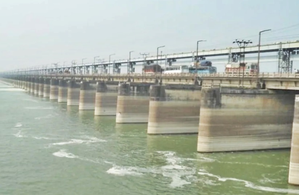
The Farakka Barrage, located in West Bengal's Murshidabad district, has been a focal point of India-Bangladesh relations for decades.
Built primarily to divert water from the Ganga to the Hooghly river to flush out silt and improve navigability for the Kolkata port, it has also been at the heart of one of South Asia's most sensitive transboundary water disputes.
Interestingly, the earlier treaties were signed between the leadership in both the countries, who had then just assumed office -- in less than a year's time.
The first "Agreement on sharing of the Ganges waters at Farakka" was signed in Dhaka on November 7, 1977.
Barely a few months ahead of the treaty, Morarji Desai had assumed office as India's Prime Minister in March, while Major-General Ziaur Rahman became the Bangladesh President in April that year.
Again, when the second arrangement was signed on December 12, 1996, both the Prime Ministers, India's H.D. Deve Gowda, and Sheikh Hasina of the Bangladesh had been in office for only six months.
Both leaders had assumed their respected offices in June.
This time, India has a stable and enduring government at the Centre led by the Prime Minister Narendra Modi while Bangladesh is inching towards establishing a democratically-elected government after nearly 17 months of volatility.
It is to be seen if the treaty is renewed later this year by mutual consent, or with some improvements, or if New Delhi takes a firm stand if Dhaka continues to play into the hands of some international players that wish to destabilise India.
Given the prevailing situation, New Delhi may not hesitate in taking action to defend the security and integrity of the country and its people.
Incidentally, India put the Indus Waters Treaty in abeyance with Pakistan's continued support for cross-border terrorism, lately including the deadly terror attack in Pahalgam in April 2025.
The decision was part of a broader package of retaliatory measures to defend India's sovereignty and against Pakistan's actions, including precision strikes across the border on terror launchpads.
The Farakka Barrage project was conceived in the 1950s and completed in 1975.
Its primary aim was to divert up to 40,000 cusecs of water from the Ganga into the Hooghly to prevent siltation at Kolkata port.
However, Bangladesh (then East Pakistan) feared that upstream diversion would reduce dry-season flows, affecting agriculture, fisheries, and navigation.
Tensions escalated after the barrage became operational in April 1975, coinciding with a politically turbulent period in Bangladesh.
The absence of a long-term agreement led to intermittent ad-hoc arrangements in the late 1970s and 1980s, but mistrust persisted.
The 1996 Treaty provided a breakthrough, which was hailed as a diplomatic success.
It provided a 30-year framework for sharing Ganga waters during the critical dry season (January–May).
Based on a 10-day period flow measurement at Farakka, with a guaranteed minimum of 35,000 cusecs for each country in certain conditions, the implementation is overseen by a joint committee which is also responsible for resolving disputes.
While the treaty reduced tensions, its implementation has faced several challenges.
Climate change, glacial retreat, and upstream water use in India's states have reduced dry-season flows, making allocations harder to meet.
Bangladesh has often alleged that it receives less than its due share, especially in drought years, while India cites hydrological constraints.
Over the past decade, cooperation between India and Bangladesh has expanded in trade, connectivity, and security.
However, water remains a politically sensitive subject in Bangladesh, where public opinion often views India's upstream projects with suspicion.
Additionally, the Teesta River dispute, unresolved for more than a decade, has further complicated perceptions.
In this context, the Farakka treaty's renewal will be a litmus test for the bilateral trust.
Disclaimer: This post has been auto-published from an agency feed without any modifications to the text and has not been reviewed by an editor
Open in app