
India-Oman CEPA maintains balanced approach to market access and safeguards
By IANS | Updated: January 10, 2026 16:00 IST2026-01-10T15:58:21+5:302026-01-10T16:00:08+5:30


New Delhi, Jan 10 The India–Oman CEPA establishes a comprehensive framework covering trade in goods and services, investment, ...
India-Oman CEPA maintains balanced approach to market access and safeguards
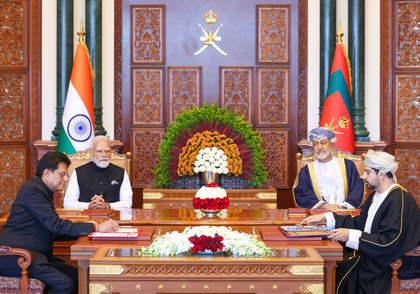
New Delhi, Jan 10 The India–Oman CEPA establishes a comprehensive framework covering trade in goods and services, investment, professional mobility, and regulatory cooperation, while maintaining a balanced approach to market access and safeguards -- expected to boost bilateral trade, generate employment, strengthen supply chains, and support deeper and more sustained economic engagement between India and Oman, an official statement said on Saturday.
Trade and commerce have been a key pillar of bilateral cooperation between India and Oman, with both sides recognizing the potential for further growth and diversification in bilateral trade.
During FY 2024–25, bilateral trade between the two countries stood at $10.61 billion, compared to $8.94 billion in FY 2023–24. Trade during the period April–October 2025 stood at $6.48 billion.
Under the CEPA, India secures 100 per cent duty-free market access for its exports to Oman, covering 98.08 per cent of Oman’s tariff lines and accounting for 99.38 per cent of India’s trade value, based on the average for 2022–23. All zero-duty concessions apply from the first day of the agreement’s entry into force, providing immediate certainty to exporters.
Presently, only 15.33 per cent of India’s export value and 11.34 per cent of tariff lines (2022–24 average) enters the Omani market at zero duty under the MFN (Most Favored Nation) regime. With CEPA, Indian exports to Oman that earlier faced duties of up to 5 per cent, valued at around $3.64 billion, are expected to gain significantly from improved price competitiveness.
The agreement opens export opportunities across engineering goods, pharmaceuticals, agriculture and processed food, marine products, textiles, chemicals, electronics, plastics, and gems and jewellery.
A calibrated liberalisation approach, including an exclusion list, protects sensitive sectors while supporting MSMEs, labour-intensive industries, and region-wide export growth, according to the official statement.
“With enhanced access to Oman’s import market of over $28 billion, supported by streamlined regulatory procedures, reduced compliance requirements, and faster market entry, Indian exporters are well positioned to expand their presence across multiple product segments,” it added.
At the same time, India has placed multiple tariff lines in the exclusion list. This move intends to protect key domestic sectors and sensitive value-chain industries and also safeguard manufacturing competitiveness and farmer interests.
Disclaimer: This post has been auto-published from an agency feed without any modifications to the text and has not been reviewed by an editor
Open in app