
Is Ethanol Safe for Your Vehicle? Nitin Gadkari Says ‘No Engine Failures, No Impact on Performance’
By Lokmat Times Desk | Updated: December 11, 2025 14:18 IST2025-12-11T14:16:35+5:302025-12-11T14:18:22+5:30



The government informed the Lok Sabha on Thursday that the use of ethanol-blended petrol has significantly benefitted farmers while ...
Is Ethanol Safe for Your Vehicle? Nitin Gadkari Says ‘No Engine Failures, No Impact on Performance’
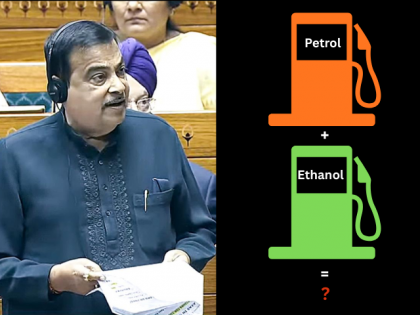
The government informed the Lok Sabha on Thursday that the use of ethanol-blended petrol has significantly benefitted farmers while helping India save more than Rs 1.40 lakh crore in foreign exchange. Addressing concerns linked to ethanol-based fuel, Union Road Transport and Highways Minister Nitin Gadkari said that extensive testing has shown “no adverse impact” on vehicles using ethanol-mixed petrol. Calling the shift a green milestone, he stated, “Use of E-20 petrol (Ethanol Blended Petrol) is a healthy trend. It is a green transition. It is less polluted and also saves foreign exchange.” Gadkari added that farmers earned Rs 40,000 crore through raw materials supplied for ethanol production.
Echoing this stance, Union Petroleum Minister Hardeep Singh Puri highlighted the economic benefits of ethanol blending, noting that money previously spent on crude oil imports now reaches the agricultural sector. He said farmers have effectively become “Urjadaatas” in addition to “Annadatas.” Puri added that between ESY 2014-15 and ESY 2024-25 (up to July 2025), ethanol blending by public sector Oil Marketing Companies led to foreign exchange savings exceeding Rs 1,40,000 crore. Despite this progress, the rollout of E20 fuel — containing 20% ethanol — has triggered concerns among vehicle owners regarding engine compatibility and long-term performance impacts.
VIDEO | Parliament Winter Session: “20 per cent ethanol gets added in our petrol. Testing has been done, and it was found that no vehicle engine failures were observed, no impact on vehicle performance was reported,” says Union Minister Nitin Gadkari in Lok Sabha.
— Press Trust of India (@PTI_News) December 11, 2025
(Source: Third… pic.twitter.com/rxxPWV2pBn
Speaking with the reporters in Delhi, Nitin Gadkari said, “The Rs 22 lakh crore that goes out of the country - shouldn’t we stop this? When we started talking about ethanol, the price of maize went up, and people began farming maize, thrice of what was being done earlier… According to our calculations, if we plant 360 crore trees, the pollution level will decrease by the same amount as ethanol does. Look at how much pollution Delhi has - such things will not happen, and farmers in the villages will benefit from it.”
VIDEO | Delhi: Union Minister Nitin Gadkari (@nitin_gadkari) says, “The Rs 22 lakh crore that goes out of the country - shouldn’t we stop this? When we started talking about ethanol, the price of maize went up, and people began farming maize, thrice of what was being done… pic.twitter.com/3RwM1EfSAn
— Press Trust of India (@PTI_News) December 11, 2025
Is E20 Safe For Your Vehicles?
A recent Local Circles survey, collecting 37,000 responses from 331 districts, revealed that 28% of owners of vehicles purchased in 2022 or earlier reported unusual wear and tear after using E20 fuel. Respondents cited issues involving the engine, carburettor, fuel tank, fuel line, and related components. The poll also showed that 52% of participants preferred offering E20 petrol as an optional variant at a 20% lower price rather than enforcing uniform pricing nationwide. These findings reinforce ongoing anxieties about the readiness of older vehicles for high-ethanol blends and the need for a phased approach.
Automotive industry experts have confirmed potential performance changes with E20 usage, noting possible efficiency losses of 2–5%, depending on the vehicle model. Engineers associated with leading automakers told PTI that older, non-E20-compliant vehicles may experience gradual erosion of gaskets, rubber hoses, and pipes. One expert explained, “There can be a drop in mileage ranging from 2 to 5%, depending on the type of vehicle. This is purely because of the lower calorific value of ethanol compared to petrol,” adding that such effects vary according to the vehicle’s design. Newer engines, however, are better equipped to handle higher ethanol concentrations.
The Indian government introduced E20 petrol in April 2023 to reduce emissions and strengthen the country’s clean-energy targets. The fuel blend contains 20% ethanol and 80% petrol, and its nationwide rollout has created uncertainty among owners of older models designed for E10. While E20 adoption promises reduced carbon output and lower crude imports, vehicles not built for higher ethanol content may experience 5–7% drops in fuel efficiency and accelerated wear. Though modern flex-fuel vehicles can handle E20 smoothly, most cars on Indian roads today remain calibrated for E10, making the transition challenging for many consumers.
Open in app