
Sustainable development must deliver equality, says former CJI Gavai at NALSAR Ambedkar Memorial lecture
By ANI | Updated: April 14, 2026 18:50 IST2026-04-15T00:19:51+5:302026-04-14T18:50:03+5:30



New Delhi [India], April 14 : Former Chief Justice of India (CJI) BR Gavai on Tuesday stressed that development ...
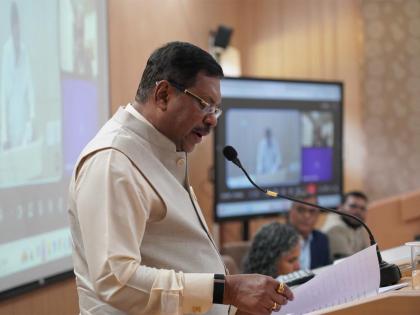
Sustainable development must deliver equality, says former CJI Gavai at NALSAR Ambedkar Memorial lecture
New Delhi [India], April 14 : Former Chief Justice of India (CJI) BR Gavai on Tuesday stressed that development in India cannot be considered sustainable unless it is rooted in substantive equality, cautioning that economic progress without social justice risks deepening existing inequalities.
Delivering the inaugural Ambedkar Memorial Lecture at NALSAR University of Law on the occasion of Dr B R Ambedkar's 135th birth anniversary, he called for a constitutional approach that integrates environmental sustainability with inclusive growth.
Speaking on the theme 'Sustainable Development and Substantive Equality: A Constitutional Dialogue,' Justice (retd) Gavai highlighted that while development is often measured through infrastructure and growth, equality remains a constitutional promise tied to dignity and inclusion. He posed a central questionwhether development can truly be sustainable if it excludes large sections of societyand argued that both concepts must be understood together rather than in isolation.
Drawing from BR Ambedkar's Constituent Assembly speech, the former CJI underlined the continuing contradiction between political equality and social and economic inequality in India. He said structural inequalities persist in access to resources, opportunities, and basic dignity, making it essential to move beyond formal equality toward substantive equality that actively addresses historical disadvantages.
The lecture highlighted how environmental challenges disproportionately affect marginalized communities. Citing examples from Maharashtra, Justice Gavai pointed to droughts, farmer distress in Vidarbha, extreme heat conditions, and the plight of Adivasi communities, noting that climate and environmental impacts are not experienced equally. He observed that vulnerable populations bear the harshest consequences due to limited access to resources and institutional support.
He further emphasized that sustainable development must go beyond environmental conservation to address social hierarchies. "Development must not deepen existing inequalities or impose disproportionate burdens on the vulnerable," he said, adding that policies must be evaluated not only for efficiency but also for their ability to reduce vulnerability and redistribute opportunities.
Justice Gavai also called for a rethinking of governance and policy design, particularly in areas such as climate adaptation, disaster response, and urban planning. He noted that one-size-fits-all approaches often reinforce inequality and stressed the need for targeted measures that reach marginalized groups, including informal workers and those outside formal systems.
Focusing on urban development, he questioned the disparity between well-developed areas and neglected settlements inhabited by the poor. He pointed out that workers who sustain urban economies are often excluded from basic amenities like housing, sanitation, and clean environments, describing this as a failure of inclusive planning.
Gavai suggested that universities can act as "laboratories of constitutional governance" by implementing inclusive practices on campuses. He proposed measures such as better working conditions for contractual staff, access to healthcare and nutrition, and educational opportunities for workers' families, stressing that sustainability must include social justice.
Concluding his lecture, the former CJI Gavai warned that a model of development that leaves large sections of society behind is inherently unsustainable and risks perpetuating the contradictions highlighted by BR Ambedkar. He urged policymakers, institutions, and society at large to align development with the constitutional vision of equality and justice.
The event also marked the launch of initiatives under the BR Ambedkar Chair at NALSAR, including research projects, annual lectures, and proposed academic programmes focused on anti-discrimination law and marginalized perspectives, aimed at advancing constitutional dialogue in the years ahead.
Disclaimer: This post has been auto-published from an agency feed without any modifications to the text and has not been reviewed by an editor
Open in app