
India needs to scale clean energy deployment, drive higher citizen adoption
By IANS | Updated: January 10, 2026 09:35 IST2026-01-10T09:34:29+5:302026-01-10T09:35:13+5:30


New Delhi, Jan 10 India needs to further strengthen its renewable energy (RE) ecosystem and scale clean energy ...
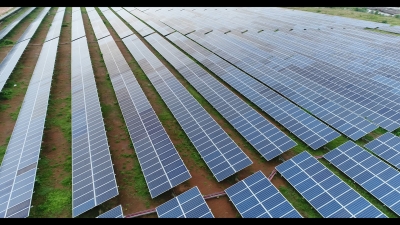
India needs to scale clean energy deployment, drive higher citizen adoption
New Delhi, Jan 10 India needs to further strengthen its renewable energy (RE) ecosystem and scale clean energy deployment, according to a senior government official.
Santosh Sarangi, Secretary, Ministry of New and Renewable Energy, said that India’s renewable energy journey over the last decade has been nothing short of spectacular, marked by phenomenal leapfrogging in global rankings.
“Our strategy has been defined by a single-minded national objective pursued across three clear verticals: accelerating RE deployment, achieving Atmanirbharta (self-reliance) in manufacturing, and driving higher citizen adoption,” he said while launching the report by the Energy and Resources Institute (TERI) at the 'Bharat Climate Forum 2026' here.
“Through a strategic combination of policy initiatives and trade instruments, we have scaled our solar capacity from a mere 2.63 GW in 2014 to over 134 GW today. This transition is not just about capacity; it is about building a resilient, self-sufficient ecosystem that serves as a blueprint for global energy shifts,” Sarangi told the gathering.
Dr Vibha Dhawan, Director General, TERI, said that their landmark macro-level study, ‘Reassessment of Solar Potential in India’, points to a horizon of unparalleled abundance: an aggregate solar potential exceeding 10,800 GW, spanning multiple modalities including ground-mounted, rooftop, and other emerging deployment pathways.
“This abundance changes the strategic question in front of us. When a country has this scale of clean energy opportunity, the issue is no longer whether we can deploy enough solar. The real question is whether we will capture enough value at home through manufacturing, technology, skills, and resilient supply chains, while keeping electricity affordable for households and industry,” Dhawan mentioned.
The report notes that while India has built significant strength in module manufacturing, with domestic module capacity far exceeding current annual demand, critical vulnerabilities persist upstream.
India continues to import nearly all of its polysilicon and the vast majority of wafers, creating risks that could constrain future solar deployment if upstream capacity is not established in time.
Without focused incentives for domestic equipment manufacturing and accelerated R&D, these dependencies could expose India’s solar sector to supply-chain disruptions, foreign exchange volatility, and geopolitical risks, said the report.
The report underscores that access to affordable, blended finance will be decisive in enabling large-scale upstream investments.
It highlights the role of sovereign “Green-PV” bonds, co-equity participation by national investment institutions, concessional debt from development finance institutions, and risk-mitigation instruments in reducing the cost of capital and improving the bankability of upstream fabs.
The study further recommends the development of Solar–Semicon Technology Parks, shared pilot fabs for next-generation technologies, and a dedicated PV–Semicon Skill Council to strengthen innovation pipelines and workforce readiness, with a particular emphasis on linking incentives to skilling outcomes and greater participation of women in manufacturing.
Disclaimer: This post has been auto-published from an agency feed without any modifications to the text and has not been reviewed by an editor
Open in app