
INST scientists find natural protein that can reshape future of electronic materials
By IANS | Updated: January 10, 2026 11:45 IST2026-01-10T11:43:03+5:302026-01-10T11:45:23+5:30


New Delhi, Jan 10 A team of scientists from Institute of Nano Science and Technology (INST), Mohali, an ...
INST scientists find natural protein that can reshape future of electronic materials
New Delhi, Jan 10 A team of scientists from Institute of Nano Science and Technology (INST), Mohali, an autonomous institute of the Department of Science and Technology (DST), have discovered semiconductor property of a known self-assembling bacterial shell protein could pave the way for safe, environmentally friendly electronics -- from mobile phones and smart watches to medical instruments and environmental sensors.
Traditional semiconductor materials, such as silicon, are valuable technological tools; however, they also have limitations. They are rigid, require high-energy processing, and contribute to the growing problem of electronic waste. Thus, there is increasing demand for sustainable, soft, and biocompatible electronics (wearables, implantable, green sensors).
The INST scientists experimented with self-assembling bacterial shell proteins to explore whether the proteins that naturally form stable, large flat 2D sheets with built-in electron density patterns and aromatic residues could be intrinsically photoactive.
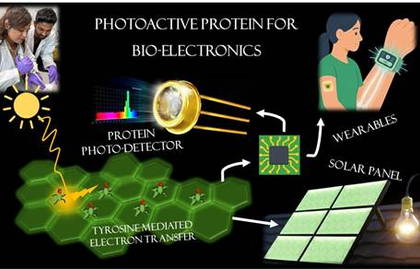
They found that when the proteins form flat, sheet-like films, they absorb UV light and generate an electrical current without any added dyes, metals, or external power and act as light-driven, scaffold-free semiconductors, much like the materials used in electronic circuits and sensors.
Further, the team discovered that these proteins naturally arrange themselves into thin, sheet-like structures. When UV light shines on them, tiny electrical charges begin to move across the protein surface.
“This happens because the proteins contain tyrosine, a natural amino acid that can release electrons when excited by light. As these electrons and protons move, the protein sheet produces an electrical signal -- similar to how a miniature solar cell would operate. This light-driven effect relies on the protein’s internal order and does not require any synthetic additives or high-temperature manufacturing,” said the team led by Dr. Sharmistha Sinha, together with student researchers Silky Bedi and S. M. Rose.
“The discovery opens up exciting possibilities for real-world applications. Because the material is flexible and body-friendly, it could be used to create wearable health monitors, skin-safe UV-detection patches, and implantable medical sensors that work safely inside the human body,” the team said.
In the paper, published in the journal Chemical Science of the Royal Society of Chemistry, the team could also be used in temporary or disposable environmental sensors, such as pollution detectors or sunlight trackers, that naturally break down after use without harming the environment.
Families, patients, and consumers may one day benefit from soft, comfortable, and environmentally responsible devices that integrate smoothly into daily life.
Disclaimer: This post has been auto-published from an agency feed without any modifications to the text and has not been reviewed by an editor
Open in app