
India can't rely on foreign algorithms; must build its own AI models to protect jobs, data, intelligence: Gautam Adani
By ANI | Updated: December 28, 2025 14:35 IST2025-12-28T14:31:57+5:302025-12-28T14:35:04+5:30



Baramati (Maharashtra) [India], December 28 : Adani Group Chairman Gautam Adani on Sunday made a strong case for India ...
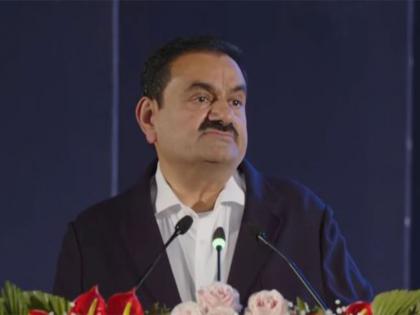
India can't rely on foreign algorithms; must build its own AI models to protect jobs, data, intelligence: Gautam Adani
Baramati (Maharashtra) [India], December 28 : Adani Group Chairman Gautam Adani on Sunday made a strong case for India building its own sovereign AI capabilities, warning that unchecked dependence on foreign technologies could pose serious economic and strategic risks for the country, as he stressed that artificial intelligence has emerged as a defining force of the fourth industrial revolution.
"Because growth without sovereignty creates dependence. And progress without control creates risk. While job creation is vital, a nation of 1.4 billion people cannot afford to place its jobs, data, culture, and collective intelligence at the mercy of foreign algorithms and foreign balance sheets," Gautam Adani said while addressing students, researchers and policymakers after inaugurating the Sharadchandra Pawar Centre of Excellence in Artificial Intelligence at Vidya Pratishthan in Baramati, Pune district.
The AI centre, funded by the Adani Group, has been established under Vidya Pratishthan, the educational institution governed by the Pawar family.
Maharashtra Deputy Chief Minister Ajit Pawar and NCP-SCP chief Sharad Pawar attended the inauguration.
The Adani Group also signed a Memorandum of Understanding (MoU) with Vidya Pratishthan to deepen collaboration in artificial intelligence research, engineering and execution.
Setting the tone for his address, Gautam Adani reflected on the transformative nature of technology across history, remarking, "while the seeds of yesterday were sown in the earth, the seeds of tomorrow will be sown in the algorithm."
He said human progress has never been linear but has advanced in powerful leaps driven by technological revolutions.
"Human progress does not move in a straight line. It advances in leaps. Each leap propelled by a technology revolution that first unsettles society, and then rebuilds it at a far higher level of capability," he said, tracing the journey from steam and mechanisation to electrification, digital computing and now artificial intelligence.
Calling AI the defining force of the fourth industrial revolution, Gautam Adani acknowledged the anxiety that accompanies major technological transitions.
"What history teaches us is that every such transition carries two opposing forces. Extraordinary opportunity and profound anxiety. Fear of displacement, fear of irrelevance, fear of giving up control to systems, we do not yet fully understand."
"These fears are not a sign of weakness. They are deeply human," he added, stressing that such concerns must be addressed responsibly.
Drawing on historical evidence, Gautam Adani argued that technology has consistently expanded employment rather than destroying it.
"Technology does not destroy work. They first disrupt roles and then expand possibilities."
He cited global examples to underline his point, noting that the first industrial revolution increased employment in Britain more than fivefold, while the second created mass manufacturing and a new middle class.
"The third, the digital revolution, did not eliminate work. It accelerated innovations and produced software, services, platforms, and entrepreneurship that now employ hundreds of millions globally," Gautam Adani noted.
Turning to India's experience, Gautam Adani said the mobile revolution had unleashed unprecedented economic energy at the grassroots level.
"Bharat's own experience offers clear evidence. The mobile revolution, much as many feared, did not destroy jobs. Instead, it multiplied them at a massive scale. When smartphones and low-cost data reach ordinary Bhartiyas, it releases an enormous surge of economic energy at the grassroots."
He cited data showing that between 1991 and 2024, India added over 230 million non-farm jobs, most of them after the expansion of digital infrastructure.
These opportunities, he said, did not arise from policy or capital alone, but when capability reached the common citizen.
"And therefore, I can confidently say that artificial intelligence will now represent the next and far more powerful leap," Gautam Adani said, adding, "Because if mobile gave Bharat greater access, AI will give Bharat greater capability."
Painting a picture of an AI-enabled future, Gautam Adani said artificial intelligence would embed capability, decision-making and productivity across every sector.
"Imaging, that over this decade, as 1.4 billion Bhartiya start to carry AI-powered intelligence in the palm of their hands, progress will no more be linear. It will compound, accelerate, and explode," he supplemented.
He described how AI could transform everyday lives from farmers using AI to optimise crops and manage risk in real time, to homemakers in tier-III towns building global microbrands.
However, Adani cautioned that AI is also a "double-edged knife".
Against this backdrop, Adani said Bharat must treat AI as a strategic national capability "built in Bharat, governed in Bharat and aligned with a Bharat national interest."
He said the Sharadchandra Pawar Centre of Excellence in AI arrives at a moment of immense national significance, as India seeks to position itself at the forefront of the global AI revolution. "The AI future is not something that will automatically arrive in Bharat. It is something our nation must build."
Adani also outlined the Adani Group's investments in AI infrastructure, including data centres and green energy, describing them as "factories of intelligence" essential to sovereignty, productivity, and security.
Disclaimer: This post has been auto-published from an agency feed without any modifications to the text and has not been reviewed by an editor
Open in app