
Nicolas Maduro — the first working-class President of Venezuela who refused to give up power
By IANS | Updated: January 3, 2026 18:40 IST2026-01-03T18:37:48+5:302026-01-03T18:40:25+5:30


Caracas, Jan 3 Venezuelan President Nicolas Maduro Moros, who was "captured and flown out" of the country by ...
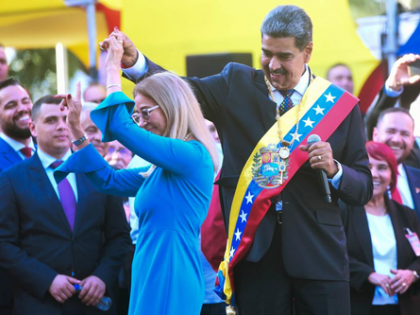
Nicolas Maduro — the first working-class President of Venezuela who refused to give up power
Caracas, Jan 3 Venezuelan President Nicolas Maduro Moros, who was "captured and flown out" of the country by the US forces early Saturday had accused Washington of playing a "dangerous game" in the region, a few months ago.
"What the current US government is doing is creating a false narrative to justify military action, to start a war in South America for regime change," Maduro had told former Ecuadorian President Rafael Correa in an interview for Russian news network RT.
Born in Caracas on November 23, 1962, Maduro completed his secondary studies at the Jose Avalos High School. He was a member of the Socialist League and, at a very young age, began working as a driver for the Caracas Metro, where he eventually became a member of the Board of Directors and a union leader. He was also the founder of the new Caracas Metro Workers' Union (SITRAMECA).
As a member of the Bolivarian Revolutionary Movement 200 (MBR-200), Maduro was a prominent activist for the freedom of Venezuelan politician and revolutionary Hugo Chavez - who eventually labelled him as his successor - when the latter was imprisoned for his participation in the 1992 military uprising.
Maduro used to meet clandestinely with social groups that supported the revolutionary process and played a prominent role in the National Directorate of the MBR-200 (1994-1997). He was a National Founder of the Bolivarian Workers' Force (FBT), an organisation of which he was the National Coordinator.
Elected Principal Deputy for the Federal District for the five-year term (2000-2005), Maduro presided over the National Assembly between January and August 2006, at which time he was called to assume the Ministry of Foreign Affairs, a position from which he promoted, together with Commander Hugo Chavez, the creation and consolidation of ALBA (2001); Petrocaribe (2005); Unasur (2008) and CELAC (2010).
On October 10, 2012, he was appointed Executive Vice President and on March 8, 2013, a few days after the death of President Chavez, appointed by constitutional mandate as the Acting President of Venezuela.
On April 14, 2013, he was elected Constitutional President of the Bolivarian Republic of Venezuela, becoming the first Chavista and working-class President in the contemporary history of Venezuela.
After winning the July 2024 presidential election with a 51.95 per cent of vote, Maduro was sworn in as Venezuelan President for a third term in January 2025.
Taking the oath before National Assembly President Jorge Rodriguez and on the Constitution, Maduro pledged to ensure "peace, prosperity, equality and the new democracy" in Venezuela.
In his post-oath speech, Maduro called for a broad dialogue process in the country "to advance together toward a major constitutional reform that will further democratize Venezuela."
The reform, he said, aims to update "the principles of the Constitution based on the new economy and society," and "to defend the country from new technological threats."
Later in the year, Xinhua news agency reported, Maduro reiterated that, contrary to accusations made by Donald Trump's administration, which seeks to link his government to the drug cartels, "Venezuela is a free country, completely free from the phenomenon of drug trafficking."
Washington's real concern "is oil, not drug trafficking," he said, adding it also aims to take control of the South American country's other natural resources.
In November 2025, US President Donald Trump said he would not rule out the use of military force in Venezuela by land to dismantle what the Trump administration calls "narco-terrorists."
Reports cited that Maduro allegedly refused to give up power and made his own demands, including global immunity from prosecution and being allowed to retain control of the military if he steps down.
On Saturday, Trump announced that the United States has struck Venezuela and captured its President, who was flown out of the country along with his wife.
"The United States of America has successfully carried out a large scale strike against Venezuela and its leader, President Nicolas Maduro, who has been, along with his wife, captured and flown out of the Country," Trump said in a Truth Social post, adding that the operation "was done in conjunction with US Law Enforcement."
Disclaimer: This post has been auto-published from an agency feed without any modifications to the text and has not been reviewed by an editor
Open in app