
No talks under shadow of blockades and threats: Iran's President Pezeshkian to Pak PM Shehbaz Sharif
By ANI | Updated: April 26, 2026 04:55 IST2026-04-26T10:24:06+5:302026-04-26T04:55:05+5:30



Tehran [Iran], April 26 : Iranian President Masoud Pezeshkian has delivered a firm "no" to direct negotiations with the ...
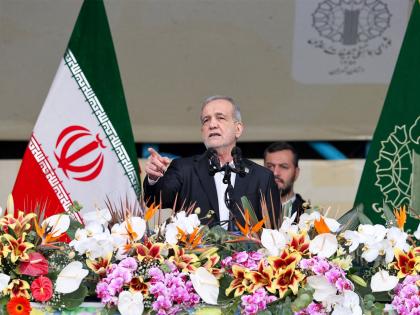
No talks under shadow of blockades and threats: Iran's President Pezeshkian to Pak PM Shehbaz Sharif
Tehran [Iran], April 26 : Iranian President Masoud Pezeshkian has delivered a firm "no" to direct negotiations with the United States as long as the current naval blockade remains in place.
According to Press TV, in a significant telephone conversation with Pakistani Prime Minister Shehbaz Sharif on Saturday, Pezeshkian asserted that Iran will not be coerced into a deal through "pressure or threats."
President Pezeshkian emphasised that the primary obstacle to peace is not a lack of dialogue, but the "hostile actions" currently being enforced by Washington.
During the conversation, the Iranian President stressed that "Iran will not enter into negotiations under pressure, threats, or blockade...As long as hostile actions and pressures of the US do not stop, rebuilding trust and progress in the path of dialogue would remain difficult."
He called on the US to demonstrate its seriousness by removing the military and economic barriers that have characterised the recent escalation.
"Our advice to the US is to first remove obstacles, including the naval blockade, in order to resume dialogue and provide a platform for resolving issues," he added.
The call comes at a critical juncture in the eight-week-long conflict, following the failure of high-level peace talks in Islamabad and a subsequent U.S. naval blockade that has choked Iranian ports since April 13.
The President's comments follow a weekend of diplomatic friction that saw a breakdown in the mediation efforts hosted by Pakistan
US President Donald Trump defended his decision to cancel a trip by envoys Jared Kushner and Steve Witkoff to Pakistan, dismissing it as "too expensive" and "too long" for a meeting with unrecognised officials.
Speaking at Palm Beach International Airport, Trump said Tehran's proposal "offered a lot but not enough," particularly in response to a US proposal seeking a 20-year suspension on enriched uranium.
Trump had called off the visit of senior adviser Jared Kushner and special envoy Steve Witkoff, who were scheduled to travel to Islamabad for a fresh round of negotiations. He cited long travel times, high costs, and the absence of senior Iranian leadership in the proposed meetings.
"We're not going to be travelling 15-16 hours to have a meeting with people that nobody ever heard of before," Trump said, calling himself a "cost-conscious person."
Despite the cancellation, Trump claimed that Iran quickly submitted a revised and "much better" proposal, reiterating that Washington's core demand remains unchanged: Iran must not acquire nuclear weapons. He also downplayed concerns over a ceasefire, saying he "hasn't even thought about it."
Earlier, Iranian Foreign Minister Abbas Araghchi said Tehran had shared a "workable framework" with Pakistani leadership to permanently end the conflict, while questioning US commitment to diplomacy.
The Iranian delegation later departed Islamabad after submitting an "official list of demands," leaving Pakistan's mediation efforts uncertain as tensions persist.
Notably, Araghchi is expected to revisit Pakistan on Sunday after concluding his trip to Oman.
Disclaimer: This post has been auto-published from an agency feed without any modifications to the text and has not been reviewed by an editor
Open in app