
Atal Setu Signal-Free Interchange to Slash Navi Mumbai Airport Commute to 10 Minutes
By Lokmat Times Desk | Updated: February 8, 2026 15:14 IST2026-02-08T15:13:14+5:302026-02-08T15:14:29+5:30



Air passengers travelling to the upcoming Navi Mumbai International Airport are set to benefit from a major reduction in ...
Atal Setu Signal-Free Interchange to Slash Navi Mumbai Airport Commute to 10 Minutes
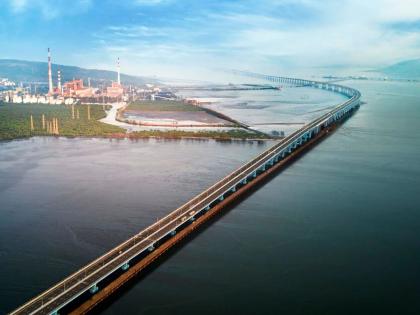
Air passengers travelling to the upcoming Navi Mumbai International Airport are set to benefit from a major reduction in travel time once a new interchange becomes operational. CIDCO has finalised the engineering design for a six-ramp, signal-free interchange at Shivaji Nagar in Gavhan village, directly linking the Atal Setu with the Ulwe Coastal Road. At present, commuters take 30 to 40 minutes to reach the airport after exiting the Atal Setu. Once the project is completed, the same stretch is expected to take barely 10 minutes, cutting the overall South Mumbai–airport journey to under 40 minutes.
The existing Shivaji Nagar junction will be transformed into a high-speed cloverleaf interchange with three-lane ramps, loops and slip roads, allowing uninterrupted traffic flow in all directions. According to CIDCO officials, the six ramps are designed to separate traffic streams as soon as vehicles enter Navi Mumbai. Dedicated loops will enable airport-bound traffic from the Atal Setu to bypass Ulwe’s internal roads, while separate connectors will manage movement toward JNPT Port, keeping heavy freight vehicles away from passenger traffic. The redesign is also expected to ease congestion in Uran and Panvel.
The interchange ramps are a key component of the 7-km Ulwe Coastal Road, which links the JNPT industrial zone, Ulwe node and the emerging Dronagiri coastal region, and also includes a railway overbridge on the Nerul–Uran line. The project, being executed by J Kumar Infraprojects Ltd, follows Bombay High Court directives to safeguard 3,728 mangroves, with triple compensatory plantation planned. Built entirely on stilts to limit environmental impact, costs have risen to nearly ₹1,591 crore. While approvals are awaited, officials continue to target August 2026 for completion.
Open in app