
Chhattisgarh: PDS shops bring relief to remote Abujhmad area through tractor-delivered rations
By ANI | Updated: April 12, 2026 18:30 IST2026-04-12T23:58:48+5:302026-04-12T18:30:03+5:30



Narayanpur (Chhattisgarh) [India], April 12 : The remote Abujhmad area of Chhattisgarh is witnessing a major transformation as tractor-delivered ...
Chhattisgarh: PDS shops bring relief to remote Abujhmad area through tractor-delivered rations
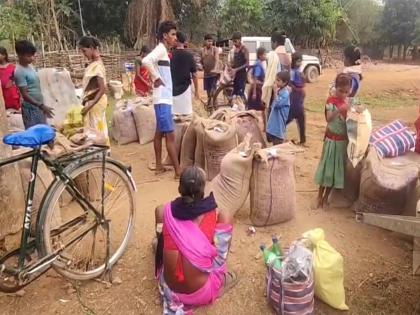
Narayanpur (Chhattisgarh) [India], April 12 : The remote Abujhmad area of Chhattisgarh is witnessing a major transformation as tractor-delivered rations under the Public Distribution System (PDS) reach villages. PDS shops are now approved at the Gram Panchayat level, with nodal officers overseeing construction and distribution in the remote area.
Speaking to ANI, Collector Namrata Jain pointed out the importance of the development, citing the struggles faced by the villages earlier.
"Earlier, villagers in interior areas had to walk 50-70 km for ration, which was even more difficult during the rains. Now, PDS shops have been approved at the Gram Panchayat level, many are under construction, and ration is delivered directly to villages by tractor. Nodal officers ensure proper arrangements, quality checks, and smooth distribution. Community buildings, PDS shops, ashrams, anganwadis and schools are being set up, while ration continues to reach villages even where storage facilities are not yet available," she said.
Local resident Gudduram Juri also emphasised the impact of the PDS. "Before, we faced difficulties due to the rain and the scorching sun. The roads weren't fully developed... We used to collect our rations from here, from Orchha. It is about 7-8 kms away. We used to come on foot. We faced many difficulties. It was extremely difficult to navigate the rocky terrain while carrying heavy loads, and we often had to wade through deep water and rain. Now, we transport ration by tractor,' he said, further thanking the Collector for continuous support.
Another local recalled the struggles they faced due to the widespread Naxalism in the region, noting that things are different presently. Now, things are convenient; a road has been built... When the Naxalites were active here previously, they used to completely block off the road... We used to go to Orcha, a distance of 20 kms (to get the ration). Our children would go hungry, and we had to travel 20 kms just to bring back rice... Now, rations are being delivered directly to your village... we receive items such as rice, ghee, salt, sugar, and chickpeas," she said.
The Public Distribution System (PDS) evolved as a system of managing scarcity through the distribution of food grains at affordable prices. PDS has become a key part of the government's food economy policy. PDS is supplemental in nature and is not intended to make available the entire requirement of any of the commodities distributed under it to a household or a section of society, according to a release from the Ministry of Food Processing Industries.
PDS is operated under the joint responsibility of the Central and the State/UT Governments. The Central Government, through Food Corporation of India (FCI), has assumed the responsibility for procurement, storage, transportation, and bulk allocation of food grains to the State Governments.
The operational responsibility, including allocation within the State, identification of eligible families, issue of Ration Cards and supervision of the functioning of Fair Price Shops (FPSs), etc., rests with the State Governments.
Under the PDS, presently the commodities, namely wheat, rice, sugar, and kerosene, are being allocated to the States/UTs for distribution. Some States/UTs also distribute additional items of mass consumption through the PDS outlets such as pulses, edible oils, iodized salt, spices, etc.
Disclaimer: This post has been auto-published from an agency feed without any modifications to the text and has not been reviewed by an editor
Open in app